A broken model gets fixed – an interview with Globalpraxis leadership
A model that still works – just not nearly as well as it could – can survive for years.
We sat down with Jean-Paul Evrard and Philippe Marmara from Globalpraxis to discuss some of the commercial beliefs they think leadership teams should challenge, and the financial consequences that can remain hidden when nobody does.
You both talk a lot about challenging conventional commercial wisdom. Why?
Jean-Paul Evrard: Because some of the most expensive decisions in a company are decisions nobody is questioning anymore. If something is obviously wrong, management acts.
What interests us are the things that look right: A large customer receives more investment because it is large, a salesperson visits an outlet every week because that has always been the frequency, a popular SKU gets more distribution because it is successful, a promotion generates volume, so it is repeated. All perfectly logical.
But are they still the best decisions? That is where we spend a lot of our time at Globalpraxis.
We challenge what appears obvious.
Can something that looks commercially successful actually destroy value?
Philippe Marmara: Absolutely. And that is one of the reasons we believe companies need to look beyond traditional KPIs.
Take promotions, for example. Suppose a promotion generates a 20% increase in volume. Everyone celebrates. But then you discover that half of that volume would have happened anyway: Another part came from consumers switching from one of your own higher-margin products, and the promotion required substantial customer investment. The 20% is still technically correct.
It is simply answering the wrong question. The real question is: How much incremental value did we create?
We see the same issue with distribution, customer investment, sales-force activity, and even market share.
A KPI can improve while the economics underneath it deteriorates.
Jean-Paul, what is one conventional belief you would challenge immediately?
Jean-Paul: That more distribution automatically means more growth.
Of course distribution matters. We have spent decades working on route-to-market. You cannot sell a product that consumers cannot find. But somewhere along the way, distribution became an objective rather than a means to an objective.
Being in 100,000 outlets is not automatically better than being in 80,000. It depends on which 20,000 outlets we are talking about.
What do they sell? What is their potential? What does it cost to serve them? What portfolio should be there? How frequently should we visit?
If we spend €10 to generate €6 of incremental gross profit, I don't care how much our numeric distribution has increased. We have created activity, not value.
That sounds obvious. Why is it still so common?
Jean-Paul: Because companies are very good at measuring what they have and far less so at measuring what they could have.
We know sales by customer. We know current volume. We know distribution. We know visit frequency. But potential is harder.
Imagine two outlets, each selling €100,000 of your products. Traditional reporting sees two similar customers. Now imagine that the realistic potential of the first outlet is €110,000 and €200,000 for the second.
They are no longer similar at all.
One has €10,000 of headroom. The other has €100,000. Yet we often find that both are being served in broadly the same way.
Multiply that type of mismatch across tens of thousands of outlets and suddenly we are no longer discussing small efficiencies. We are discussing millions.
Can these changes really be material enough to matter at CEO level?
Philippe: They have to matter at CEO level.
Globalpraxis has seen RTM and RGM transformations generate incremental sales growth in the 5–12% range, while optimization of trade investment and promotional effectiveness has released 5–10% in spend efficiency.
In one route-to-market project, a redesigned approach to fragmented trade contributed to a three-percentage-point market-share increase. In another case, restructuring the commercial model contributed to 43% volume growth and a 404% increase in EBIT.
The point is not that every company will replicate those exact numbers. The point is that commercial-system design is not a marginal efficiency exercise.
When you change how thousands of commercial decisions are made, the cumulative financial effect can be enormous.
404% EBIT sounds extraordinary. What creates that kind of difference?
Philippe: Usually, not one magic idea. That is another belief we challenge.
Executives often look for the big lever: A major price increase, a transformational technology, a new channel, or a major restructuring.
Sometimes those things are necessary, but very often the economics come from correcting dozens of smaller decisions that are happening every day: Too many intermediaries, the wrong service level, discounts being used to push volume, salespeople spending time in the wrong places, margin leaking through the distribution chain, customer segments receiving identical treatment despite completely different economics…
You fix one of those and perhaps the impact is modest. You fix them together and the business model changes.
So there is no “silver bullet”?
Jean-Paul: Very rarely.
We are suspicious when someone walks into a complex commercial organization and claims to have found the answer before spending time in the market.
We have seen beautiful strategies built from headquarters that collapse when you spend a day riding with the sales force: The spreadsheet tells you one thing, the distributor tells you another, and the retailer tells you something else.
Then you watch what actually happens in the outlet and suddenly the problem becomes clear.
This is why the outside-in perspective is so important to us at Globalpraxis.
Data tells you where to look. The market helps you understand why. You need both.
What is another conventional belief you think businesses should challenge?
Philippe: That the biggest customer deserves the biggest investment.
It may. But size is not potential.
If a €50 million customer is already highly developed and a €15 million customer has the potential to become a €30 million one, where should the next euro go?
That sounds simple when we discuss it here. Inside an organization, it is much harder: Budgets have history, relationships have history, and commercial agreements have history. People defend what they own, so money tends to follow yesterday's business.
Growth requires allocating at least part of that money according to tomorrow's opportunity.
That is a fundamentally different way to manage.
Is the same true for the sales force?
Jean-Paul: Very much so.
One question we like asking is: If we gave your sales organization 20% more capacity tomorrow, where would you put it exactly?
Not approximately, but: Which customers? Which outlets? Which activities? Which SKUs? What would the salesperson do differently when they arrived?
It is surprising how difficult that question can be.
Then we ask the opposite: If you had to reduce sales capacity by 10% tomorrow without losing profitable growth, where would you take it from?
That question can be even more revealing.
Together, the two answers tell you whether the organization really understands the productivity of its commercial resources.
Where does AI enter this discussion?
Philippe: AI makes the level of precision we are discussing increasingly possible.
Historically, companies had to simplify.
You could not manually optimize 100,000 outlets, thousands of SKUs, different service models, promotional histories, customer characteristics, and local demand signals.
So, we created segments and averages. They were necessary, and they still have a role, but now we can go much further.
We can identify an outlet that sells significantly below comparable outlets, we can detect an assortment gap, we can estimate where another visit is likely to generate value and where it probably will not, and we can identify promotional mechanics that repeatedly generate volume without generating sufficient incremental return.
That is extremely powerful.
Does that mean AI will make the decisions?
Jean-Paul: No. And I think this is an important distinction.
We don't need AI to replace commercial judgement. We need it to make commercial judgement better informed.
There is a tendency today to start with technology: “We need an AI sales solution.”
We prefer to start somewhere else: Which commercial decisions are costing you the most money today?
Then ask whether data and AI can improve those decisions.
That sequence matters. Otherwise, you risk putting sophisticated technology on top of a commercial model that should have been redesigned first.
You simply make the wrong model faster.
What do you mean by a “hidden business consequence”?
Jean-Paul: Let me give you a simple example.
Imagine 10,000 outlets. Suppose the commercial model misallocates only €1,000 of potential per outlet each year. That does not sound dramatic when you look at one outlet.
Across the network, it is €10 million.
Now imagine a company operating across several markets with 50,000, 100,000, or 200,000 customer interactions.
Small mistakes become very large numbers. This is the part leadership teams sometimes underestimate.
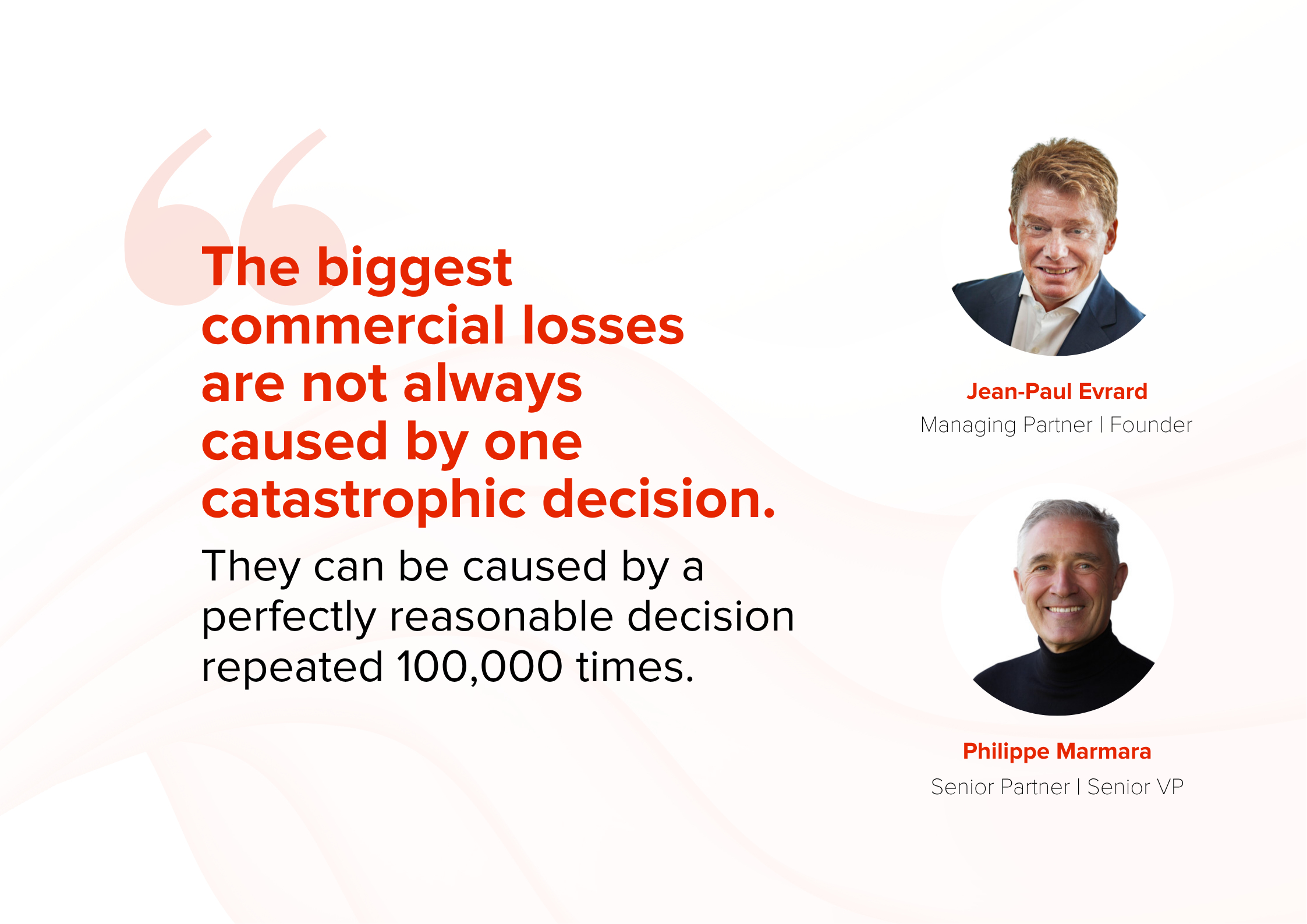
The biggest commercial losses are not always caused by one catastrophic decision.
They can be caused by a perfectly reasonable decision repeated 100,000 times.
Philippe, where do you see this most often in RGM?
Philippe: Promotions and trade investment are obvious areas.
Imagine a business spending €200 million annually on trade and promotional investment.
If better targeting and commercial discipline can improve efficiency by 5%, that is €10 million. At 10%, it is €20 million.
You do not need a revolutionary new business model to create significant value. You need to stop spending money where the incremental return does not justify it and redirect it towards places where it does.
That is why we think the future of RGM is not simply about pricing. It is about precision.
And where do you see it in RTM?
Jean-Paul: Cost-to-serve is a major one.
Companies frequently know the gross margin of a customer but not the full economics of serving that customer: Sales visits, order taking, warehousing, picking, delivery, returns, distributor margins, administration, trade investment…
Once those elements are included, the customer economics can look very different.
Sometimes an account everyone believes is profitable is much less attractive than expected. Sometimes a relatively small customer deserves substantially more attention.
And sometimes the right decision is not to abandon a customer but to serve them differently: Digitally, indirectly, with a lower frequency, and with a different minimum order or assortment.
Route-to-market is fundamentally about making those choices deliberately.
You seem to be arguing that companies don't necessarily need more resources.
Philippe: Exactly. That is probably another belief worth challenging.
When growth slows, the conversation often becomes: What more can we do? Meaning more activation, more distribution, more salespeople, more promotions, and more investment.
Our first question is often different: What would happen if we used what we already have, better?
Where are we overserving? Where are we underinvesting? Which promotions should disappear? Which customer activities generate little incremental return? Where is sales-force time being consumed without sufficient value?
Growth does not always require adding resources. Sometimes it requires having the courage to reallocate them.
If you could leave CEOs and CCOs with one question, what would it be?
Jean-Paul: I would ask:
If you designed your commercial model from zero today, would you build the one you currently have?
With today's customers, today's channels, today's technology, cost base, consumer behavior…
Would you create the same territories? The same distributor structure? The same service frequencies? And the same customer segmentation, trade terms, and KPIs?
If the answer is no, then the difference between those two models deserves serious attention.
Philippe?
Philippe: Mine would be even simpler:
Where are your next €10 million actually coming from?
Not “from premiumization.” Not “from digital.” Not “from route-to-market.”
Show me the customers, outlets, products, occasions, price points, and commercial actions.
If we cannot point to where the growth will physically occur, we probably do not understand the opportunity well enough yet.
One final thought?
Jean-Paul: Companies spend enormous amounts of time watching competitors.
We understand why. But sometimes the largest source of competitive disadvantage is much closer.
It is in the way your own organization allocates its resources.
Philippe: And that is also the good news.
Because unlike your competitor, that is something you can change.
At Globalpraxis, after decades of working on route-to-market, revenue growth management, and commercial transformation across markets, we have become increasingly convinced of one thing:
The most valuable question in business is:
“What are we doing today that no longer makes economic sense?”
Find that. Quantify it. Change it.
The hidden consequence of conventional thinking can be enormous. So can the value of challenging it.

