Between speed, sustainability, and profit: The new equation of fashion retail
The fashion retail industry is undergoing a profound transformation. Once driven primarily by seasonal collections and physical retail expansion, it is now shaped by digital disruption, shifting consumer expectations, and mounting economic and regulatory pressures. While European fashion retailers face specific structural constraints, many of their challenges are mirrored – and often amplified – on a global scale.
This article examines the key challenges fashion retailers are facing today, distinguishing between Europe-specific dynamics and global structural pressures, while highlighting the strategic tensions shaping the industry’s future.
Intensifying competition and market fragmentation
Fashion retail has become one of the most competitive consumer sectors. Fast fashion leaders (Zara, H&M) continue to dominate scale and speed. However, ultra-fast players (Shein, Temu) are redefining prices and cycle times, while premium and niche brands compete on the identity and sustainability arena.
This dynamic has led to margin compression and shorter product lifecycles, leaving all players feeling the constant pressure to innovate and differentiate themselves.
Europe is particularly saturated given the high density of established brands, strong presence of global competitors, and the mature consumer markets with limited organic growth.
As a result, European retailers must steal share rather than rely on market expansion.
The digital transformation imperative
Digital is no longer a channel; it is the backbone of retail. As e-commerce penetration continues to grow, consumers expect seamless omnichannel experiences.
Online platforms (Amazon, Zalando, Tmall) are reshaping distribution, hence retailers must invest heavily in data analytics, personalization, logistics, last-mile delivery, digital marketing, and customer acquisition.
Europe’s fragmented markets (languages, regulations, logistics) add additional complexity. Here, high return rates and costly reverse logistics lower profitability in e-commerce.
The challenge is not just to grow online, but to do it in an economically sustainable way.
Profitability under pressure
Fashion retailers face rising costs across the value chain, especially in raw materials, production, logistics, transportation, labor, and compliance. At the same time, price competition limits the ability to pass costs to consumers and promotions and discounting erode margins.
High operating costs (rent, labor, energy), strong retailer competition driving promotional intensity, increasing taxation, and regulatory compliance costs are some of the European pressure points.
As a result, structural tension is evident. Growth is often achieved at the expense of profitability.
Supply chain complexity and agility
Fashion supply chains are globalized, multi-tiered, and increasingly vulnerable to disruption (geopolitics, climate, logistics shocks). European brands often rely on Asian production hubs and complex import structures. Therefore, retailers must balance speed (to match trends), cost efficiency, and risk management.
However, compared to vertically integrated players (e.g., Inditex), many retailers lack full control over production and rapid replenishment capabilities, creating a disadvantage in reactivity and inventory management.
Sustainability and regulatory pressure
Sustainability, once a branding tool, is now a strategic necessity.
Consumer awareness is rising, investors increasingly demand ESG compliance, and governments are introducing stricter regulations.
Europe is at the forefront of regulatory pressure with circular economy requirements, extended producer responsibility (EPR), and transparency and traceability obligations.
The key challenge facing retailers is balancing sustainable sourcing, cost competitiveness, and speedy delivery. This is particularly difficult for fast fashion models, which inherently rely on high volumes and rapid turnover.
Changing consumer behavior
Consumers are becoming more price-sensitive, especially post-inflation, more demanding when it comes to quality, speed, and their experience, and less loyal, switching across brands and platforms.
There is also a growing polarization between demand for low-cost fashion and growth of premium and sustainable segments.
European consumers are highly promotion-driven, expecting strong value-for-money, but also increasingly sensitive to sustainability claims.
This creates a paradox: Consumers demand both lower prices and higher ethical standards.
Channel and distribution disruption
The traditional wholesale model is being challenged by direct-to-consumer (DTC) strategies, marketplaces (Amazon, Zalando, Farfetch), and social commerce and influencer-driven sales.
Retailers must decide where to sell and how to control pricing and brand image.
In Europe, multi-brand retailers and platforms have a strong role and the dependence on marketplaces for visibility is evident. This may result in loss of brand control and margin dilution.
Organizational and strategic complexity
Fashion companies are becoming more complex organizations, managing global operations and omnichannel structures through data-driven decision-making processes.
Hence, they must acquire new capabilities (analytics, digital, supply chain) and embrace cultural transformation (from intuition to data-driven decisions).
Yet, many traditional fashion players struggle to adapt quickly enough.
Core strategic tension
Across Europe, and globally, fashion retailers are facing fundamental dilemmas: Speed or sustainability? Growth or profitability? Global scale or local relevance? No single model solves all three simultaneously.
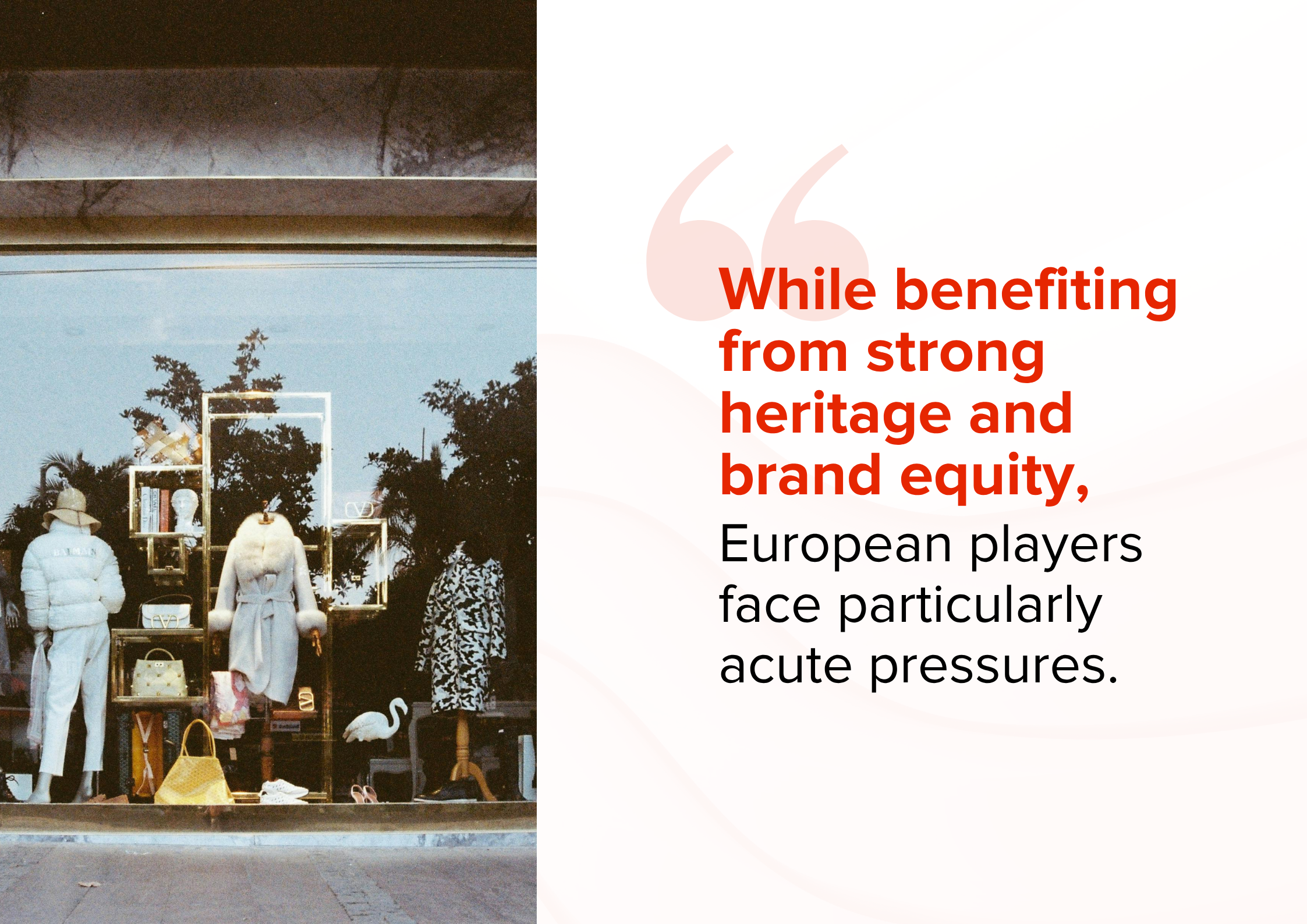
In conclusion, the fashion retail industry is entering a phase of structural transformation rather than cyclical change. European players, while benefiting from strong heritage and brand equity, face particularly acute pressures due to regulatory intensity, market maturity, and cost structures.
Globally, the rise of ultra-fast fashion, digital ecosystems, and new consumer expectations are redefining the competitive landscape.
Success in this environment will depend on building agile and resilient supply chains, leveraging data and digital capabilities effectively, integrating sustainability into the core business model, and developing clear and differentiated positioning.
Ultimately, the winners will be those who can balance operational excellence with strategic clarity in an increasingly complex and demanding global market.
