From shelf space to sell-through: The strategic shift reshaping the beverage market
For a long time, growth in the beverage industry followed a clear, almost mechanical logic: Expand distribution.
More doors meant more volume. More listings meant more visibility. And scale was primarily a function of how widely you could place your product.
That model is losing its edge.
Not that distribution no longer matters – it’s just not as scarce as it used to be.
Today innumerable brands access shelves, marketplaces, and alternative channels faster than ever, pushing real constraint downstream.
In other words, it’s no longer access that defines success.
It’s velocity.
The shift from distribution-led growth to velocity-led growth has deep strategic implications.
First, it fundamentally changes how expansion should be approached.
The old reflex was breadth: Enter as many points of sale as possible, as early as possible.
The new logic is density: Maximize performance where you are before scaling further.
In practical terms, this means treating distribution as an outcome rather than a starting point.
Gone are the days when retailers were the gatekeepers of access. Now they are the arbiters of performance. And this is seen at the shelf.
Shelf space is conditional, being re-evaluated continuously and becoming increasingly short-term: If a product doesn’t generate sufficient sell-through, it gets replaced. Quickly.
Second, it forces a redefinition of what “market traction” actually means.
Vanity metrics like number of listings, geographic presence, and even initial sell-in become secondary.
What matters is much more unforgiving:
- Rate of sale per store
- Repeat purchase behavior
- Time to rotation
- Contribution to category performance
In other words, traction is no longer about being present.
It’s about being chosen – again and again.
Third, it exposes the limits of fragmented operating models.
Velocity is not driven by one function.
It is the result of alignment across the entire system.
Brand drives initial attention. Packaging drives conversion at shelf. Pricing shapes accessibility. Sales ensures placement quality. And Operations guarantees availability.
If any of these elements are misaligned, velocity suffers, and with it, your right to remain on the shelf.
This is why many brands fail not at the point of entry, but shortly after, as they optimize for getting in rather than staying in.
Finally, the shift from a focus on distribution to velocity increases the cost of strategic mistakes.
Overdistribution, once seen as aggressive growth, can now dilute performance indicators, weaken retailer confidence, and accelerate delisting cycles.
In a velocity-driven environment, scaling too early is not just inefficient – it’s plain risky.
The brands that adapt are those that internalize a different sequence:
Prove → Densify → Scale
They therefore build strong local performance first, refining their model under real conditions, and only then expand, based on evidence, not assumptions.
This is a more disciplined path – and a more defensible one.
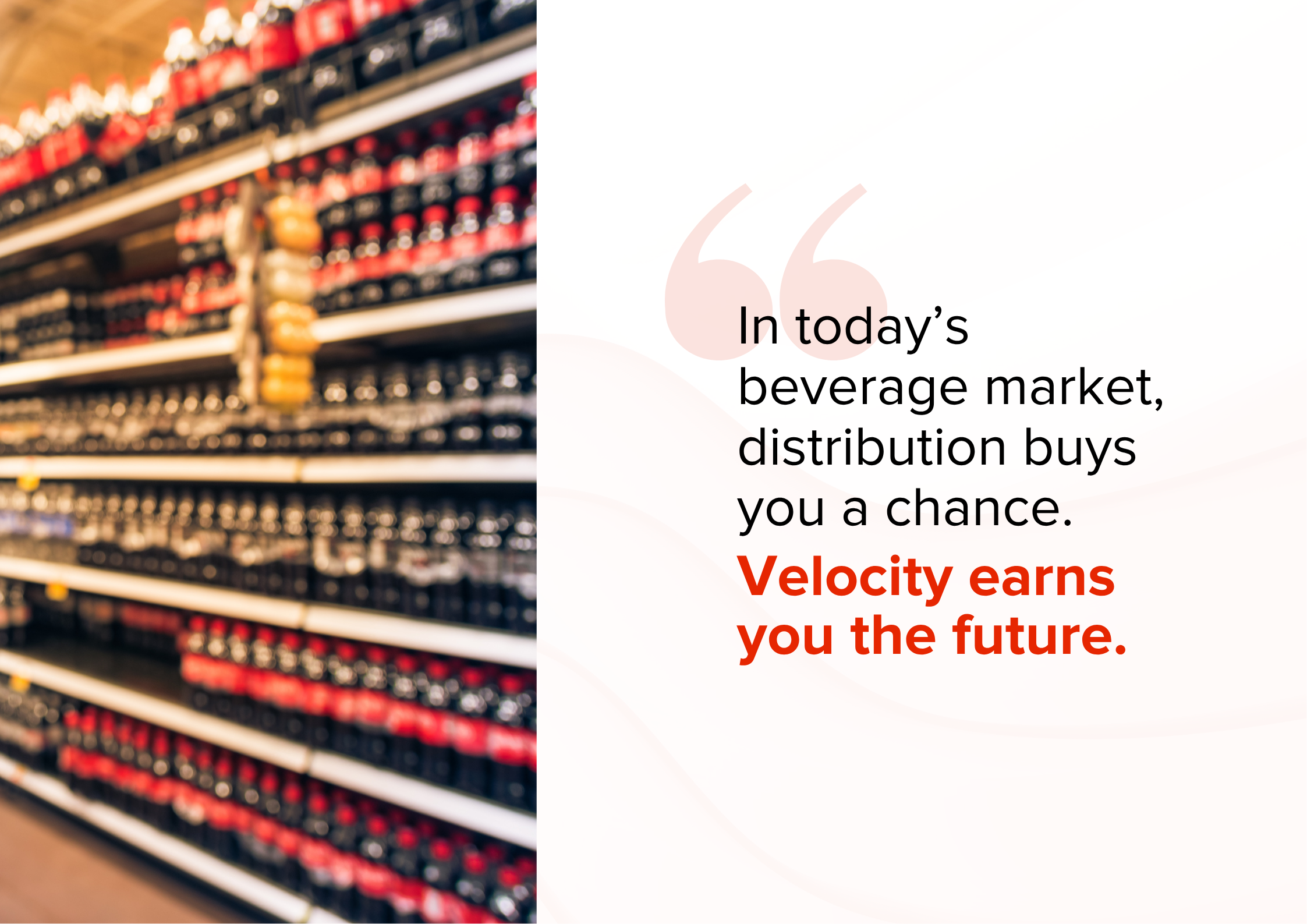
Because in today’s beverage market, distribution buys you a chance.
Velocity earns you the future.

