The hidden growth engine behind high-performing commercial organizations
After more than three decades helping companies transform their commercial organizations across more than 40 countries, we've come to one conclusion that consistently proves true.
The biggest competitive advantage in route-to-market is no longer having more salespeople, but knowing where to deploy them, what success looks like in every outlet, and how to execute consistently.
This is precisely where operational segmentation and the picture of success (PICOS) become game changers. Yet, surprisingly, many organizations still view these concepts as merchandising initiatives or sales force tools. They are neither. They are strategic business capabilities.
Every company faces the same reality: Markets are becoming more fragmented, channels are evolving faster than organizations, consumer expectations are changing continuously – like the current demand for greater customization –, and all this as resources remain limited.
At the same time, commercial organizations are expected to deliver faster growth, stronger profitability, and flawless execution. The usual response has been straightforward: Increase coverage and the number of sales calls, launch more initiatives, and develop further reporting. Unfortunately, these actions rarely solve the real problem, as commercial performance is rarely constrained by effort, but by focus.
The fundamental question is not: "How many outlets are we visiting?". Instead, we should be asking: "Are we investing our resources where they create the greatest value?"
This is exactly what operational segmentation addresses.
Operational segmentation: Far more than classifying customers
A good segmentation identifies where growth can realistically be achieved, recognizing that not every outlet has the same potential, not every customer the same needs, and not every investment generates the same return. Instead of treating thousands of outlets as one homogeneous universe, segmentation creates distinct groups based on their commercial opportunity, shopper behavior, channel role, competitive environment, and strategic importance.
This scrutiny immediately changes how resources are allocated: As sales coverage becomes differentiated, investment priorities become clearer, trade marketing more focused, innovation launches more selective, and commercial discussions flow from opportunity rather than intuition.
However, segmentation alone is not enough.
One of the most common mistakes we observe is when organizations produce sophisticated segmentation models that never change what actually happens in the marketplace. This is where the picture of success becomes essential.
PICOS: Transforming strategy into execution
The picture of success defines what "winning" genuinely means for every outlet segment. For each store profile, it establishes a clear execution framework, in answering the following:
- What assortment should be available?
- Which categories deserve priority?
- What level of visibility is expected?
- Which promotional assets create value?
- How should pricing be executed?
- Which shopper missions should be supported?
- What KPIs determine success?
But most importantly, PICOS creates alignment.
Marketing, Trade Marketing, Category Management, Sales, and Revenue Growth Management stop working independently. Everyone begins to share the same definition of success. Commercial organizations no longer debate what should happen inside the outlet but rather focus on making it happen consistently.
When segmentation and PICOS are fully integrated, organizations typically experience significant improvements across multiple dimensions.
- Commercial investments become more productive because they are concentrated where potential is greatest.
- Sales teams become more effective because priorities are simplified.
- Trade marketing budgets generate stronger returns because execution standards are tailored to outlet opportunity.
- Innovation success rates improve because launches target the right customers first.
- Retail conversations also become more strategic once recommendations are supported by data rather than opinion.
- And since execution can be measured objectively across thousands of outlets, leadership gains greater visibility.
Perhaps the greatest benefit, however, is organizational alignment.
Too often, Marketing develops ambitious activation plans and Trade Marketing designs excellent point-of-sale materials, while Sales focuses on immediate volume targets, Supply chain on optimizing inventory, and Finance on measuring costs. Each function performs well individually, yet the customer experiences fragmented execution.
Operational segmentation and PICOS create the common language that connects every commercial function around one objective: Winning where it matters most.
Of course, implementing these capabilities is not without challenges. Building an effective segmentation requires high-quality data, field validation, and continuous refinement.
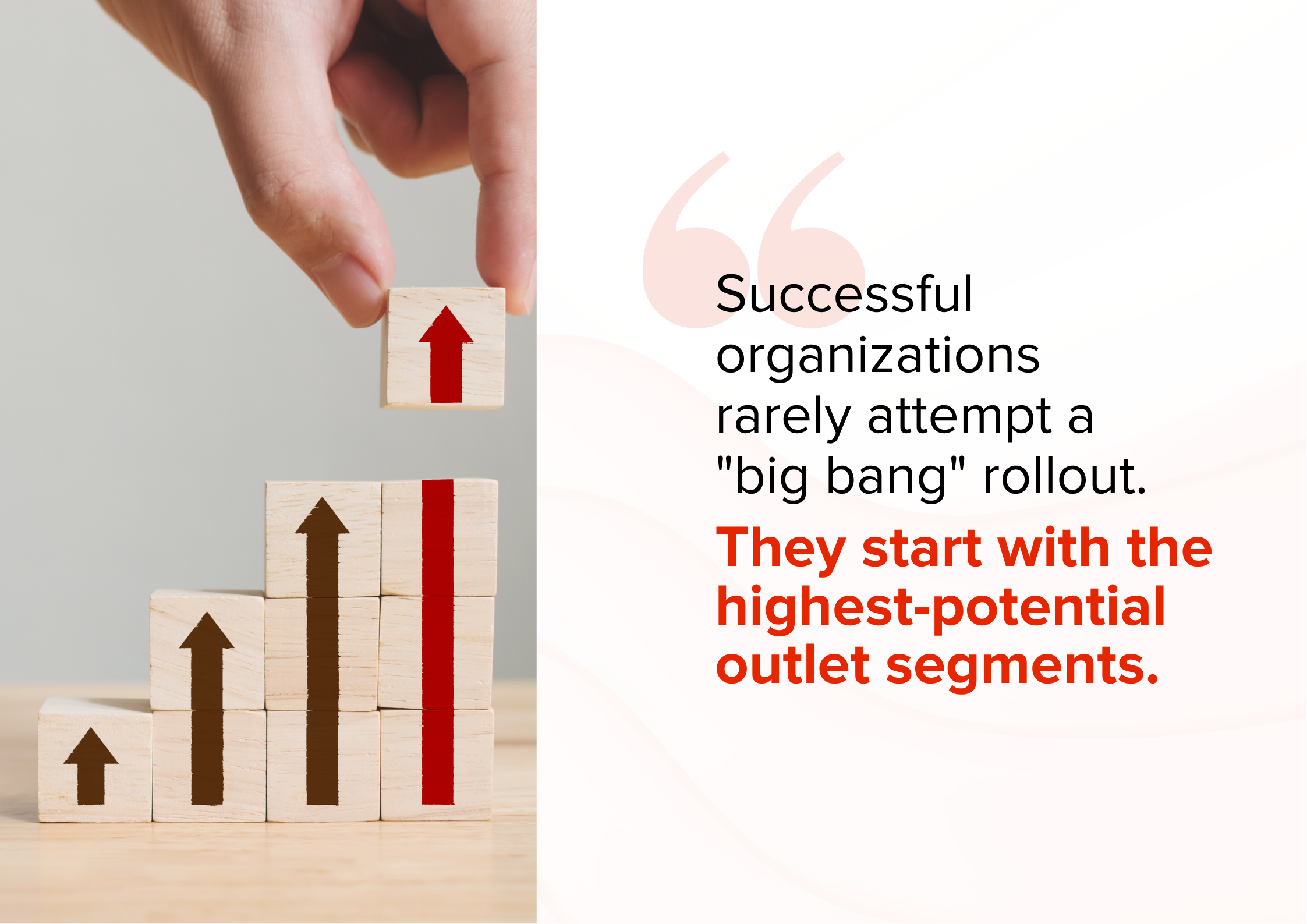
Designing a picture of success demands close collaboration across multiple departments. For example, implementation requires disciplined change management; sales teams need coaching; KPIs must evolve; governance needs to be more rigorous; and technology must support execution rather than complicate it. This is why successful organizations rarely attempt a "big bang" rollout. They start with the highest-potential outlet segments. They test, measure, learn, refine, and scale.
Over the years, we have seen one lesson repeated without fail across industries and geographies: The companies achieving sustainable commercial growth are not necessarily those with the biggest commercial budgets. On the contrary, the organizations thriving over time are those that manage to create the greatest clarity: Clarity on where to invest and on the look of success and how every function contributes to it.
Operational segmentation provides focus while PICOS provides execution discipline. Together, they transform commercial strategy into measurable marketplace performance.
And in increasingly complex and competitive markets, that may well be one of the strongest competitive advantages an organization can build.
How does your organization define success today?
Does every outlet receive the same execution model? Or does each outlet benefit from the strategy that reflects its true commercial potential?
