The rise of functional beverages and dairy in Europe and the U.S.: The strategic role of convenience stores


A converging revolution in beverages consumption
Over the past decade, and accelerating sharply since the pandemic, the beverage landscape in both Europe and the United States has undergone a profound transformation. Consumers are no longer satisfied with products that simply hydrate or provide basic nutrition. Instead, they increasingly demand functional benefits: Energy, immunity, gut health, cognitive performance, and overall wellness.
This shift has catalyzed explosive growth in:
- Functional beverages (energy drinks, fortified waters, probiotic drinks, nootropic beverages)
- Functional dairy (high-protein milk, probiotic yogurts, drinkable dairy, lactose-free innovations)
At the same time, convenience stores (c-stores) have emerged as a critical distribution battleground bridging impulse consumption, on-the-go lifestyles, and premium health positioning.
Market growth: A strong and sustained expansion
The functional beverage category is now a global powerhouse, valued at ~130 B$ in 2024 (depending on scope) and expected to reach +174 B$ by 2030 (conservative estimate). Some projections even suggest +400 B$ by 2032 under broader definitions.
Rising health consciousness and preventive care, demand for convenient, ready-to-drink (RTD) formats, the growth of fitness culture and active lifestyles, and the shift toward natural, plant-based, and clean-label ingredients are some of the key structural drivers for this category.
North America leads with ~36% market share, while Europe represents a mature but innovation-driven market.
The functionalization of dairy: From staple to performance product
Dairy, once seen as traditional and even declining, has re-emerged as a functional heavyweight. U.S. dairy sales grew +5,5% in value and +2,8% in volume in 2025, and the year before that organic dairy grew ~9,8%.
The revival is driven by high protein content, beneficial for muscle recovery and satiety, natural positioning vs. ultra-processed alternatives, and gut health awareness trends (probiotics, kefir, fermented dairy).
Key innovations include:
- High-protein milk (e.g., ultra-filtered milk)
- Drinkable yogurts and kefir
- RTD dairy beverages (coffee, chocolate, milk teas)
- Hybrid dairy-functional blends (collagen, adaptogens, probiotics)
Notably, RTD milk drinks are gaining traction due to their convenient and crave-worthy positioning.
Europe vs. U.S.: Different paths, same destination
United States: Scale, speed, and branding
The U.S. market is characterized by rapid commercialization and category creation (e.g., prebiotic sodas), the strong presence of large beverage corporations, and distinct high penetration energy drinks and performance beverages. Consumers in this market seek energy, hydration, immunity, and focus benefits through ready-to-drink formats aligned with their busy lifestyles.
Functional beverages already represent ~10% of the U.S. non-alcoholic beverage market, with rapid growth since 2020.
Europe: Premiumization and health sophistication
Europe displays a strong demand for low-sugar, clean-label, and natural formulations. As well as a steady growth in nootropics, adaptogens, and personalized nutrition with an emphasis on education, transparency, and taste.
Gut health (fiber, probiotics), cognitive enhancement (mushroom-based drinks, adaptogens), and reduced sugar and functional fortification are key trends in this market.
Europe is less aggressive in scale but more refined in formulation and positioning.
Convenience stores: The critical growth engine
While supermarkets still dominate volume, convenience stores are strategically critical because they align perfectly with functional beverage consumption occasions:
- Immediate consumption (on-the-go)
- Impulse purchases
- Urban mobility and commuting patterns
- Single-serve RTD formats
Functional beverages are inherently mission-driven purchases (energy boost, hydration, focus), making c-stores a natural channel, with innate high frequency and high margin.
Energy drinks dominate in c-stores, being the largest segment globally. Although, functional waters and RTD dairy are expanding rapidly in this channel. Premium price points are also more acceptable due to immediacy.
The role of convenience stores in category expansion
Convenience stores are not just distribution points; they are category accelerators. Here, new brands (e.g., nootropic drinks, protein shakes) gain visibility while the limited shelf space forces high-impact innovation.
Whether for their morning commute (energy drinks / protein dairy), afternoon slump (nootropics / functional sodas) or post-workout (protein shakes / recovery drinks) occasions, consumers accept higher prices for functional benefits + convenience and single-serve formats drive higher per-unit margins.
Convergence: Functional beverages and dairy blur together
A major emerging trend is category convergence: Traditional categories are emerging as new functional hybrids. For example:
- Milk – Protein-enhanced RTD drinks
- Yogurt – Drinkable probiotic beverages
- Soda – Prebiotic / low-sugar functional soda
- Energy drinks – Natural, plant-base energy + dairy blends
Dairy increasingly positioning itself as part of the functional beverage ecosystem, instead of a separate aisle.
Key consumer drivers in convenience contexts
Across both regions, Europe and the U.S., three behavioral drivers dominate:
- Soft wellness: Consumers prefer easy, enjoyable health solutions vs. extreme diets or supplements. Functional beverages provide low-effort wellness
- Time scarcity: Busy lifestyles fuel demand for ready-to-drink nutrition, portable formats, and multi-functional products (hydration + energy + nutrition)
- Personalization: Consumers increasingly seek targeted benefits, such as focus, gut health, sleep, and demographic-specific products (e.g., women-focused formulations)
Challenges and constraints
Despite strong growth, consumer skepticism about health claims, regulatory ambiguity around functional ingredients, high price points (especially in c-stores), shelf competition and saturation, and supply chain complexity for functional ingredients are some of the challenges this category is currently facing.
Strategic implications for brands and retailers
Brands should focus on clear and credible functional benefits. They need to optimize RTD, single-serve formats, and continuously invest in taste + efficacy + storytelling.
Convenience retailers need to curate high-velocity functional SKUs, while using adjacency strategies (energy + protein + hydration clusters), and emphasizing cold-chain visibility for dairy-based drinks.
Convenience as the catalyst of functional consumption
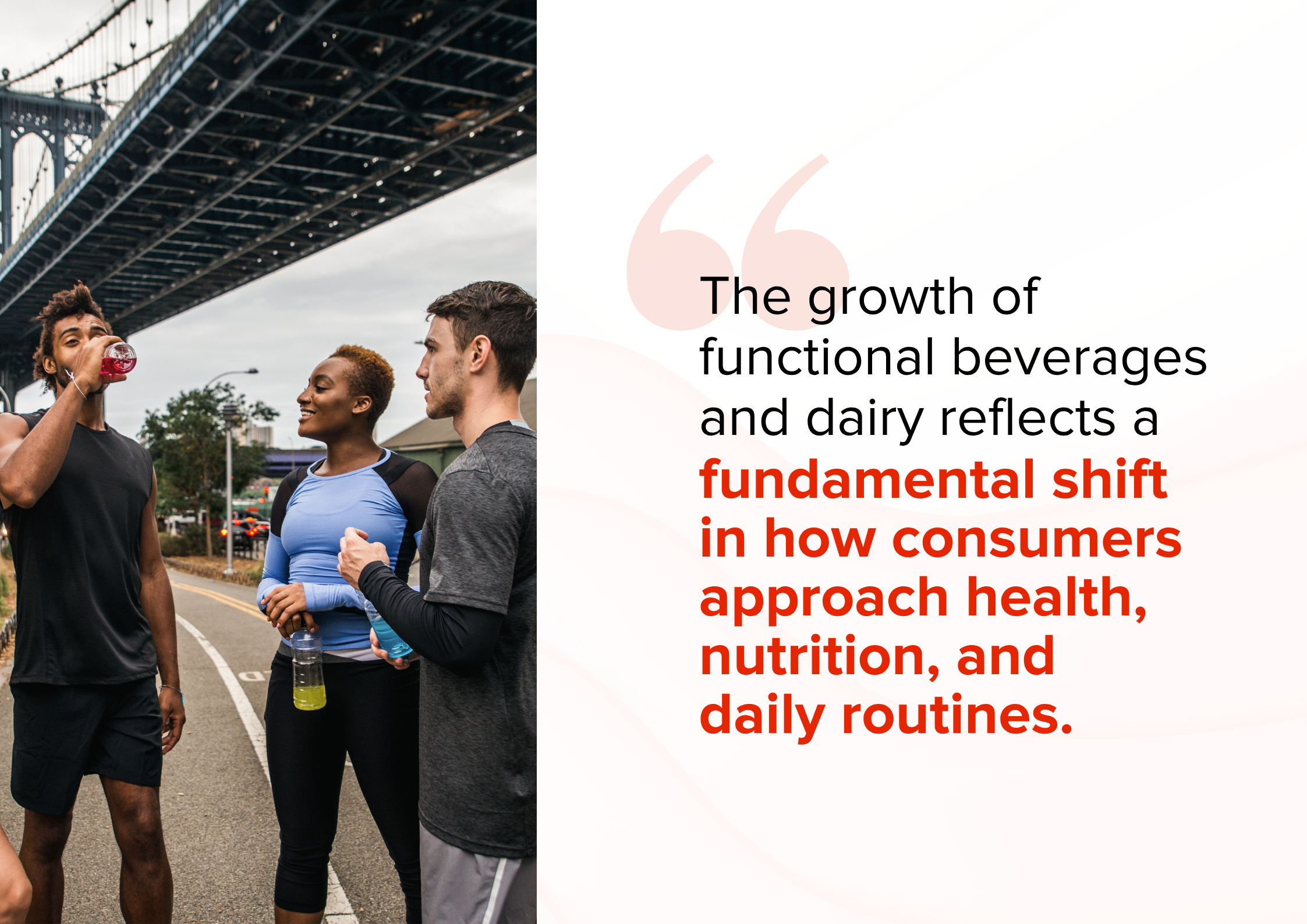
The growth of functional beverages and dairy in Europe and the U.S. is not merely a product trend, it reflects a fundamental shift in how consumers approach health, nutrition, and daily routines.
Convenience stores sit at the heart of this transformation since they translate macro health trends into daily behavior. They enable trial, immediacy, and premiumization, and act as gateways for innovation.
As functional beverages and dairy continue to converge, the winners will be those who master functional credibility, convenience-first formats, and channel-specific strategies especially in c-stores.
